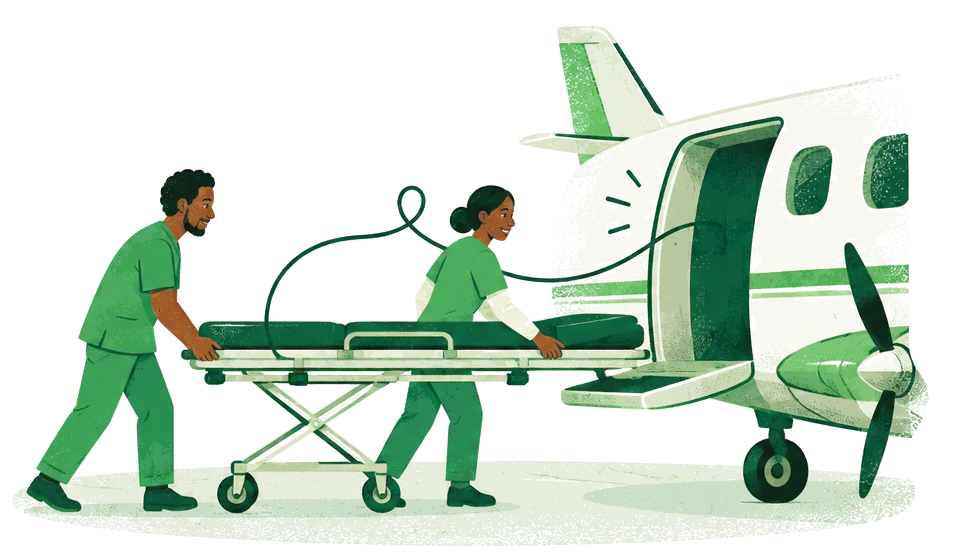
Who decides on a medical evacuation?
The Health Council, which assesses two conditions set by Order 80-0251/PR. Treatment must be impossible or clearly inadequate in Djibouti’s facilities. Treatment abroad must bring a cure or a lasting improvement.
After the return, follow-up checks must take place in Djibouti.
How does the request work?
The rules date from 1980, so ask the treating doctor which office handles the file today.
- The patient’s doctor writes a report: diagnosis and reason for evacuation.
- The file goes to the Health Council, which assesses the medical criteria.
- For a patient without means, a committee also assesses their finances.
- With insurance, call the assistance company before booking anything: it organises the transfer.
- Get the receiving hospital’s agreement, its quote and the name of the doctor who will take the patient, in writing.
Who pays for the evacuation?
The State pays only for Djiboutian civil servants, State employees and people without means. A companion is covered only if the patient’s condition or very young age justifies it. Djibouti’s embassies do not take on patients, except their own staff.
| Situation | Who pays | Left to pay |
|---|---|---|
| Djiboutian civil servant or State employee | The State: transport, hospital, treatment | Up to 10% of costs, deducted from pay, capped at two months’ salary |
| Married civil servant with a family, under 70,000 DJF a month | The State | Nothing |
| Djiboutian without means | The State, fully or partly | Set by the committee |
| AMO or PASS member | No specific rule in the AMU law | Ask the CNSS (114) before spending anything |
| Expat or privately insured | The insurer, if the policy covers it | Policy limits and exclusions |
| Anyone else | The family | Everything, on the receiving hospital’s quote |
Which country?
Four things decide: the treatment needed, a bed at the receiving hospital, the visa and who pays. For a medical visa, the destination country’s consulate lists the documents and processing times.
Which documents should you gather?
Keep every document on paper and as a photo on your phone.
- Valid passport for the patient and the companion.
- AMU or PASS card, or insurance policy number.
- Medical report with the diagnosis and reason for evacuation.
- Recent lab results and scans, with the images if possible.
- List of current treatments and allergies.
- The receiving hospital’s agreement and quote.
What about before the decision, or after the return?
Medyc does not arrange medical evacuations. In Djibouti City, Medyc arranges an appointment with a partner specialist before the decision (from 6,000 DJF), then, after the return, a doctor or nurse at home (from 5,000 DJF) and medicine delivery. In an emergency, call 119.
Before you take the next step
0/5 doneTick as you go. Nothing is saved.
Your questions, answered
Who is entitled to a State-funded medical evacuation in Djibouti?
Djiboutian civil servants, State employees and people without means, if the Health Council finds the medical criteria are met.
Does the CNSS pay for a medical evacuation abroad?
The AMU law has no specific rule on evacuations. Ask the CNSS, on 114 or in writing, before you spend anything.
Does my insurance cover medical evacuation?
Only if the policy says so: most national health insurance plans do not cover evacuation abroad. Read the policy and call the assistance line.
Can a relative travel with the patient?
Yes, but the State pays their costs only if the patient’s condition or very young age justifies it. With private insurance, check the companion clause.
Sources & further reading
- Official Journal: Order 80-0251/PR on medical evacuations
- Official Journal: Law 24/AN/14/7e L on universal health insurance
- France Diplomatie: Djibouti, health
- U.S. Embassy Djibouti: Medical Assistance
- CNSS: 114 free AMU line
- CHU de Djibouti: 119 emergency number (SMUR)
- Medyc: expat health in Djibouti
- Medyc: partner specialist appointments
This guide explains how to organise care. It does not provide a diagnosis or individual medical advice. How we write our guides